
 林渡
林渡
本文承上文:
【aarch64异常模型以及Linux arm64中断处理】
中断相关的几个概念
硬件中断号hwirq
hwirq - Hardware Interrupt Number,
定义:物理硬件设备在中断控制器中的原始编号,由硬件设计固定。
每一个中断控制器都会对连接在自己控制器下面的设备进行编号
例如:
在GIC中,中断号0-15为SGI(软件生成中断),16-31为PPI(私有外设中断),32-1019为SPI(共享外设中断)
	tlmm: pinctrl@400000 {
		compatible = "qcom,pitti-pinctrl";                  // 与驱动匹配
		reg = <0x400000 0x1000000>;
		interrupts = <GIC_SPI 227 IRQ_TYPE_LEVEL_HIGH>;     // 表示其连接在GIC中断控制器的227号共享类型中断上
		gpio-controller;                                    // 标明是一个gpio控制器
		#gpio-cells = <2>;
		interrupt-controller;                               // 标明是一个中断控制器
		#interrupt-cells = <2>;
		wakeup-parent = <&mpm>;
		qcom,gpios-reserved = <36 37 38 39>;
};这个tlmm是级联在GIC中断控制器下的227号硬件中断(hwirq)上,此时从GIC角度来看,TLMM是一个外设设备,这种情况下我们一般称之为INTID
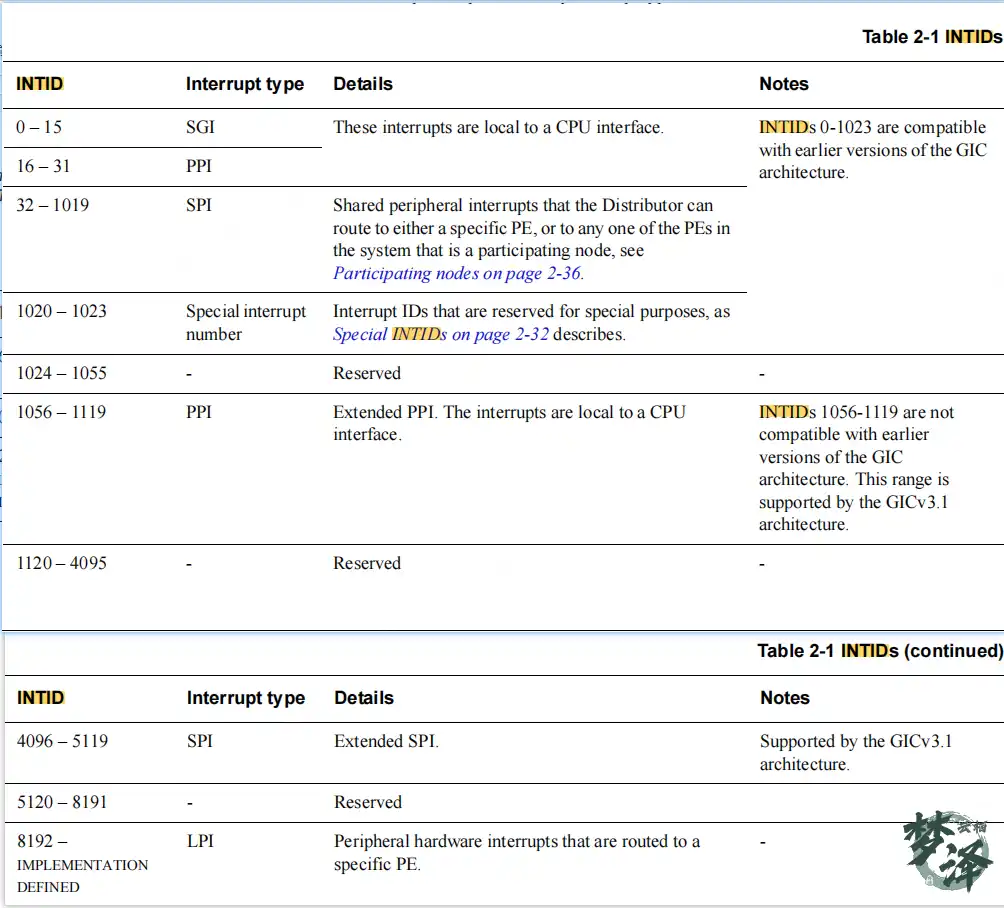
gpio在级联中断控制器上的hwirq
// 假设一个按钮设备使用TLMM的GPIO 5作为中断
button@0 {
    compatible = "gpio-keys";

    button0 {
        label = "Volume Up";
        gpios = <&tlmm 5 GPIO_ACTIVE_LOW>;
        // 中断描述:使用tlmm控制器的GPIO 5,下降沿触发
        interrupt-parent = <&tlmm>;
        interrupts = <5 IRQ_TYPE_EDGE_FALLING>;
    };
};
这个按键就是使用了TLMM的gpio5,它的中断源是TLMM,在tlmm内部的硬件中断号为5
这里提一个有意思的,在高通的irq中
  23 0x30002      0x3        19         0          0          0          0          0          0          0           qcom,smp2p-adsp                ipcc            v.v (struct irq_desc *)0xffffff8002331a00
  24 0x60002      0x3        4          0          0          0          0          0          0          0           qcom,smp2p-cdsp                ipcc            v.v (struct irq_desc *)0xffffff8002333000
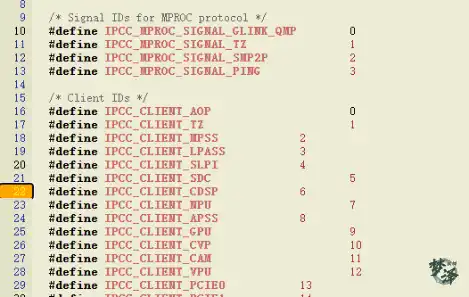
可以看到这两个中断的hwirq非常大
0x00030002
    ├── 高16位 (0x0003): 可能表示中断控制器ID或bank编号
    └── 低16位 (0x0002): 该控制器上的具体中断线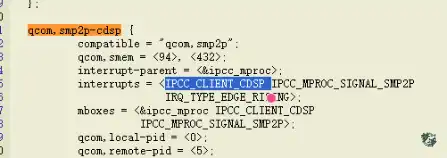
由于硬件中断号是由所属的中断控制器决定的,那么就有可能出现硬件中断号一致的情况。为了解决这个问题,linux kernel引入了虚拟中断号的概念
虚拟中断号virq
virq - Virtual Interrupt Number
定义:Linux内核抽象的统一中断编号,用于在内核中标识和管理中断。
特性:
由内核动态分配和管理
全局统一编号空间(0~NR_IRQS-1)
独立于硬件实现,提供一致的编程接口
我cat /proc/interrupts 会有这样的输出
IRQ  HWIRQ        affinity   CPU0       CPU1       CPU2       CPU3       CPU4       CPU5       CPU6       CPU7        Name                           Chip            IRQ Structure
   1 0x0          0x3        9868       10031      8613       9408       8928       9616       25598      26045       IPI                            GICv3           v.v (struct irq_desc *)0xffffff8045756a00
   2 0x1          0x3        5330       2620       2012       1851       1709       1703       17407      13294       IPI                            GICv3           v.v (struct irq_desc *)0xffffff8045755800
   3 0x2          0x3        1          1          1          1          1          1          1          0           IPI                            GICv3           v.v (struct irq_desc *)0xffffff8045757c00
   4 0x3          0x3        0          0          0          0          0          0          0          0           IPI                            GICv3           v.v (struct irq_desc *)0xffffff8045754e00
   5 0x4          0x3        0          0          0          0          0          0          0          1           IPI                            GICv3           v.v (struct irq_desc *)0xffffff8045757800
   6 0x5          0x3        8902       4995       4536       4901       4530       4886       11392      12431       IPI                            GICv3           v.v (struct irq_desc *)0xffffff8045756e00
   7 0x6          0x3        0          0          0          0          0          0          0          0           IPI                            GICv3           v.v (struct irq_desc *)0xffffff8045756600
  11 0x13         0x3        3487       3122       3065       2972       2950       2987       11748      12069       arch_timer                     GICv3           v.v (struct irq_desc *)0xffffff8045757600
  13 0x26         0x1        26         6          0          0          7          3          13         10          arch_mem_timer                 GICv3           v.v (struct irq_desc *)0xffffff8045754200
  15 0x15         0x3        11         10         10         9          9          9          49         50          arm-pmu                        GICv3           v.v (struct irq_desc *)0xffffff800b2e1800
  16 0x16e        0x3        12345      0          0          0          0          0          0          0           ipcc_0                         GICv3           v.v (struct irq_desc *)0xffffff80020f8c00
  17 0xe5         0x3        0          0          0          0          0          0          0          0           mpm                            GICv3           v.v (struct irq_desc *)0xffffff800b2e4c00
  18 0x56         0x3        0          0          0          0          0          0          0          0           None                           mpm-gic         v.v (struct irq_desc *)0xffffff8002468a00
  19 0x0          0x3        0          0          0          0          0          0          0          0           volume_up                      spmi-gpio       v.v (struct irq_desc *)0xffffff8002468c00
  20 0x103        0x3        0          0          0          0          0          0          0          0           None                           GICv3           v.v (struct irq_desc *)0xffffff80457c2600
  21 0x61         0x3        0          0          0          0          0          0          0          0           wifi_ant_check                 msmgpio         v.v (struct irq_desc *)0xffffff80023c6400
  22 0x20         0x3        0          0          0          0          0          0          0          0           apps_wdog_bark                 GICv3           v.v (struct irq_desc *)0xffffff8002235800
  23 0x30002      0x3        19         0          0          0          0          0          0          0           qcom,smp2p-adsp                ipcc            v.v (struct irq_desc *)0xffffff8002331a00
从图中可以得到以下的结论:
第一列就是virq,第二列就是hwirq
virq是唯一的,但是hwirq不是唯一的
从hwirq到virq必然存在着一条映射关系
中断线
“中断线”就是:硬件里一根用来把“某个设备有事要 CPU 处理”的信号送到中断控制器/CPU 的线路(信号通路)。
但在 Linux 里大家说“中断线”经常有两层含义:物理和逻辑
物理中断线
在 SoC/板级电路上,外设会有一个
IRQ引脚(或内部连线)。这根线接到中断控制器(比如 GIC 的某个 SPI 输入、GPIO 控制器的某个中断输入)。
线上的电平/脉冲变化(高/低、上升沿/下降沿)就代表“中断请求”。
例子:
网卡 IRQ 引脚 → 接到 GIC 的 SPI#74
某 GPIO 引脚作为中断输入 → 接到 GPIO 控制器,再由 GPIO 控制器汇聚到 GIC 的某个 SPI
这就是“线”的本体。
逻辑中断线
在中断控制器内部,“每个输入/每个可识别的中断源”通常都会对应一个硬件中断号(hwirq/INTID)。
这时大家也会把“某个 hwirq”称为“一条中断线”。
对 GIC:一条“线”常常就对应一个 INTID(比如 SPI INTID=74)。
对 GPIO 控制器:一个 GPIO pin 作为中断源,也可以认为是一条“线”(GPIO 控制器里有自己的 hwirq 号)。
这里提一个知识点:共享中断
共享中断就是:多个设备共用同一根物理线/同一个硬件中断输入,所以在 Linux 里表现为:
多个
irqaction挂在同一个irq_desc上(同一个 virq 上注册了多个 handler)中断来了要挨个问:“是不是你触发的?”
中断相关的数据结构
中断描述符irq_desc
/**
 * struct irq_desc - interrupt descriptor
 * @irq_common_data:	per irq and chip data passed down to chip functions
 * @kstat_irqs:		irq stats per cpu
 * @handle_irq:		highlevel irq-events handler
 * @action:		the irq action chain
 * @status_use_accessors: status information
 * @core_internal_state__do_not_mess_with_it: core internal status information
 * @depth:		disable-depth, for nested irq_disable() calls
 * @wake_depth:		enable depth, for multiple irq_set_irq_wake() callers
 * @tot_count:		stats field for non-percpu irqs
 * @irq_count:		stats field to detect stalled irqs
 * @last_unhandled:	aging timer for unhandled count
 * @irqs_unhandled:	stats field for spurious unhandled interrupts
 * @threads_handled:	stats field for deferred spurious detection of threaded handlers
 * @threads_handled_last: comparator field for deferred spurious detection of threaded handlers
 * @lock:		locking for SMP
 * @affinity_hint:	hint to user space for preferred irq affinity
 * @affinity_notify:	context for notification of affinity changes
 * @pending_mask:	pending rebalanced interrupts
 * @threads_oneshot:	bitfield to handle shared oneshot threads
 * @threads_active:	number of irqaction threads currently running
 * @wait_for_threads:	wait queue for sync_irq to wait for threaded handlers
 * @nr_actions:		number of installed actions on this descriptor
 * @no_suspend_depth:	number of irqactions on a irq descriptor with
 *			IRQF_NO_SUSPEND set
 * @force_resume_depth:	number of irqactions on a irq descriptor with
 *			IRQF_FORCE_RESUME set
 * @rcu:		rcu head for delayed free
 * @kobj:		kobject used to represent this struct in sysfs
 * @request_mutex:	mutex to protect request/free before locking desc->lock
 * @dir:		/proc/irq/ procfs entry
 * @debugfs_file:	dentry for the debugfs file
 * @name:		flow handler name for /proc/interrupts output
 */
struct irq_desc {
	struct irq_common_data	irq_common_data;
	struct irq_data		irq_data;
	unsigned int __percpu	*kstat_irqs;        // 中断统计
	irq_flow_handler_t	handle_irq;             // 流处理函数
	struct irqaction	*action;	/* IRQ action list */   // IRQ动作链表
	unsigned int		status_use_accessors;
	unsigned int		core_internal_state__do_not_mess_with_it;
	unsigned int		depth;		/* nested irq disables */   // 禁止嵌套计数
	unsigned int		wake_depth;	/* nested wake enables */
	unsigned int		tot_count;
	unsigned int		irq_count;	/* For detecting broken IRQs */
	unsigned long		last_unhandled;	/* Aging timer for unhandled count */
	unsigned int		irqs_unhandled;
	atomic_t		threads_handled;
	int			threads_handled_last;
	raw_spinlock_t		lock;
	struct cpumask		*percpu_enabled;
	const struct cpumask	*percpu_affinity;
#ifdef CONFIG_SMP
	const struct cpumask	*affinity_hint;
	struct irq_affinity_notify *affinity_notify;
#ifdef CONFIG_GENERIC_PENDING_IRQ
	cpumask_var_t		pending_mask;
#endif
#endif
	unsigned long		threads_oneshot;
	atomic_t		threads_active;
	wait_queue_head_t       wait_for_threads;
#ifdef CONFIG_PM_SLEEP
	unsigned int		nr_actions;
	unsigned int		no_suspend_depth;
	unsigned int		cond_suspend_depth;
	unsigned int		force_resume_depth;
#endif
#ifdef CONFIG_PROC_FS
	struct proc_dir_entry	*dir;
#endif
#ifdef CONFIG_GENERIC_IRQ_DEBUGFS
	struct dentry		*debugfs_file;
	const char		*dev_name;
#endif
#ifdef CONFIG_SPARSE_IRQ
	struct rcu_head		rcu;
	struct kobject		kobj;
#endif
	struct mutex		request_mutex;
	int			parent_irq;
	struct module		*owner;
	const char		*name;
} ____cacheline_internodealigned_in_smp;
可以把 irq_desc 理解成:Linux 对某个 virq 的“全生命周期管理对象”,核心信息都挂在这上面。
核心成员介绍:
这条 IRQ 用什么“流控/派发逻辑”
handle_irq:flow handler
决定:是 level/edge?是否 EOI?是否 percpu?是否 oneshot?
常见函数:
handle_level_irq / handle_edge_irq / handle_fasteoi_irq / handle_percpu_devid_irq ...
注意:
handle_irq不是设备驱动的 handler,它是 IRQ core 级的“派发器”。
这条 IRQ 上挂了哪些“设备处理函数”
action:指向 struct irqaction 的链表头
共享中断时:一个
irq_desc挂多个irqaction非共享时:通常只有一个
irqaction
这条 IRQ 的硬件相关信息
irq_data(或嵌套结构):里面有irq、hwirq、domain、chip、chip_data等irq_chip:这条线由哪个 irqchip 驱动控制(mask/unmask/ack/eoi/set_type…)
状态与同步
自旋锁(如
desc->lock):保护 action 链表、状态位等深度/禁用计数、pending、统计、亲和性、唤醒等状态
中断域irq_domain
struct irq_domain {
	struct list_head link;
	const char *name;
	const struct irq_domain_ops *ops;
	void *host_data;
	unsigned int flags;
	unsigned int mapcount;

	/* Optional data */
	struct fwnode_handle *fwnode;
	enum irq_domain_bus_token bus_token;
	struct irq_domain_chip_generic *gc;
	struct device *dev;
#ifdef	CONFIG_IRQ_DOMAIN_HIERARCHY
	struct irq_domain *parent;
#endif

	ANDROID_KABI_RESERVE(1);
	ANDROID_KABI_RESERVE(2);
	ANDROID_KABI_RESERVE(3);
	ANDROID_KABI_RESERVE(4);

	/* reverse map data. The linear map gets appended to the irq_domain */
	irq_hw_number_t hwirq_max;
	unsigned int revmap_size;
	struct radix_tree_root revmap_tree;
	struct mutex revmap_mutex;
	struct irq_data __rcu *revmap[];
};
irq_domain 是中断号翻译/分配体系的核心对象
常见重要成员:
ops:irq_domain_ops(.translate/.alloc/.free/.select)revmap[]/revmap_tree:hwirq→irq_data 的表(GIC 通常用线性数组 revmap)parent:层级 domain 时指向父 domainhwirq_max / revmap_size:线性映射范围
几个关键点总结:
每个 irq_domain 都有自己的 revmap 和 revmap_tree:
revmap是一个 线性数组,通常用于 较小或密集的中断号,它用于存储 hwirq → irq_data 的映射。revmap_tree是一个 radix tree(类似哈希表),通常用于 更大范围的中断号(当中断号的数量比较大时,它提供了更好的查找效率)。
hwirq 是 irq_domain 自己维护的:
每个
irq_domain都维护自己的revmap,因此一个 GIC domain 和一个 GPIO domain 会有各自独立的hwirq范围,它们的hwirq号是相互独立的。比如 GIC domain 会有一组
INTID号,和 GPIO domain 的GPIO_PIN号完全不同,且是 分别管理 的。
如何查找 hwirq 对应的 virq:
如果指定了
domain(例如 GIC domain 或 GPIO domain),__irq_resolve_mapping会直接根据传入的hwirq查找对应的irq_desc(以及对应的virq)。它首先会检查
revmap,如果没有找到(可能是由于hwirq较大),则会查找revmap_tree。
struct irq_domain_ops {
	int (*match)(struct irq_domain *d, struct device_node *node,
		     enum irq_domain_bus_token bus_token);
	int (*select)(struct irq_domain *d, struct irq_fwspec *fwspec,
		      enum irq_domain_bus_token bus_token);
	int (*map)(struct irq_domain *d, unsigned int virq, irq_hw_number_t hw);
	void (*unmap)(struct irq_domain *d, unsigned int virq);
	int (*xlate)(struct irq_domain *d, struct device_node *node,
		     const u32 *intspec, unsigned int intsize,
		     unsigned long *out_hwirq, unsigned int *out_type);
#ifdef	CONFIG_IRQ_DOMAIN_HIERARCHY
	/* extended V2 interfaces to support hierarchy irq_domains */
	int (*alloc)(struct irq_domain *d, unsigned int virq,
		     unsigned int nr_irqs, void *arg);
	void (*free)(struct irq_domain *d, unsigned int virq,
		     unsigned int nr_irqs);
	int (*activate)(struct irq_domain *d, struct irq_data *irqd, bool reserve);
	void (*deactivate)(struct irq_domain *d, struct irq_data *irq_data);
	int (*translate)(struct irq_domain *d, struct irq_fwspec *fwspec,
			 unsigned long *out_hwirq, unsigned int *out_type);
#endif
#ifdef CONFIG_GENERIC_IRQ_DEBUGFS
	void (*debug_show)(struct seq_file *m, struct irq_domain *d,
			   struct irq_data *irqd, int ind);
#endif
};
.translate:把 DT/ACPI 的中断描述翻译成 hwirq + type/flags.select:在多 domain 情况下选哪个 domain.alloc:当需要“新建映射”时分配一批 virq 并完成初始化分配 virq 号(
__irq_alloc_descs()就是其中关键步骤)建立 revmap
设置 irq_chip / flow handler 等信息
.free:释放映射(动态中断源/卸载时)
struct irq_data
很多时候会发现函数参数是 struct irq_data *d 而不是 irq_desc*。irq_data 是更“硬件抽象层”的那层。它将 desc / chip / domain / hwirq/virq 串在一起。
struct irq_data {
	u32			mask;
	unsigned int		irq;
	unsigned long		hwirq;
	struct irq_common_data	*common;
	struct irq_chip		*chip;
	struct irq_domain	*domain;
#ifdef	CONFIG_IRQ_DOMAIN_HIERARCHY
	struct irq_data		*parent_data;
#endif
	void			*chip_data;
};
典型字段:
irq:virqhwirq:硬件号(GIC INTID)domain:所属 irq_domainchip:irq_chip 指针chip_data:irqchip 私有数据(比如 GIC 的指针/寄存器基址信息等)
struct irq_chip
struct irq_chip {
	const char	*name;
	unsigned int	(*irq_startup)(struct irq_data *data);
	void		(*irq_shutdown)(struct irq_data *data);
	void		(*irq_enable)(struct irq_data *data);
	void		(*irq_disable)(struct irq_data *data);

	void		(*irq_ack)(struct irq_data *data);
	void		(*irq_mask)(struct irq_data *data);
	void		(*irq_mask_ack)(struct irq_data *data);
	void		(*irq_unmask)(struct irq_data *data);
	void		(*irq_eoi)(struct irq_data *data);

	int		(*irq_set_affinity)(struct irq_data *data, const struct cpumask *dest, bool force);
	int		(*irq_retrigger)(struct irq_data *data);
	int		(*irq_set_type)(struct irq_data *data, unsigned int flow_type);
	int		(*irq_set_wake)(struct irq_data *data, unsigned int on);

	void		(*irq_bus_lock)(struct irq_data *data);
	void		(*irq_bus_sync_unlock)(struct irq_data *data);

#ifdef CONFIG_DEPRECATED_IRQ_CPU_ONOFFLINE
	void		(*irq_cpu_online)(struct irq_data *data);
	void		(*irq_cpu_offline)(struct irq_data *data);
#endif
	void		(*irq_suspend)(struct irq_data *data);
	void		(*irq_resume)(struct irq_data *data);
	void		(*irq_pm_shutdown)(struct irq_data *data);

	void		(*irq_calc_mask)(struct irq_data *data);

	void		(*irq_print_chip)(struct irq_data *data, struct seq_file *p);
	int		(*irq_request_resources)(struct irq_data *data);
	void		(*irq_release_resources)(struct irq_data *data);

	void		(*irq_compose_msi_msg)(struct irq_data *data, struct msi_msg *msg);
	void		(*irq_write_msi_msg)(struct irq_data *data, struct msi_msg *msg);

	int		(*irq_get_irqchip_state)(struct irq_data *data, enum irqchip_irq_state which, bool *state);
	int		(*irq_set_irqchip_state)(struct irq_data *data, enum irqchip_irq_state which, bool state);

	int		(*irq_set_vcpu_affinity)(struct irq_data *data, void *vcpu_info);

	void		(*ipi_send_single)(struct irq_data *data, unsigned int cpu);
	void		(*ipi_send_mask)(struct irq_data *data, const struct cpumask *dest);

	int		(*irq_nmi_setup)(struct irq_data *data);
	void		(*irq_nmi_teardown)(struct irq_data *data);

	unsigned long	flags;
};
irq_chip 是 irqchip 驱动提供的一组方法,让通用 IRQ core 能控制具体硬件:
常见回调:
.irq_mask / .irq_unmask.irq_ack(edge/某些场景).irq_eoi(EOI 模式,GIC 常用).irq_set_type(edge/level).irq_set_affinity(路由到哪个 CPU)
对 GIC:中断进来后 flow handler 往往会在合适的时机调用 chip 的 ack/eoi/mask/unmask。
在我们了解了基础数据结构后,我们会对中断处理有一个比较直观的认知:
一次中断发生时,调用栈“角色分工”总结
irq_domain:把 INTID(hwirq) 找到 virq/desc(映射层)
irq_desc->handle_irq:按中断类型做正确的 ack/eoi/mask、以及调用 action(流控层)
irqaction->handler/thread_fn:设备驱动的真正处理逻辑(业务层)
中断初始化
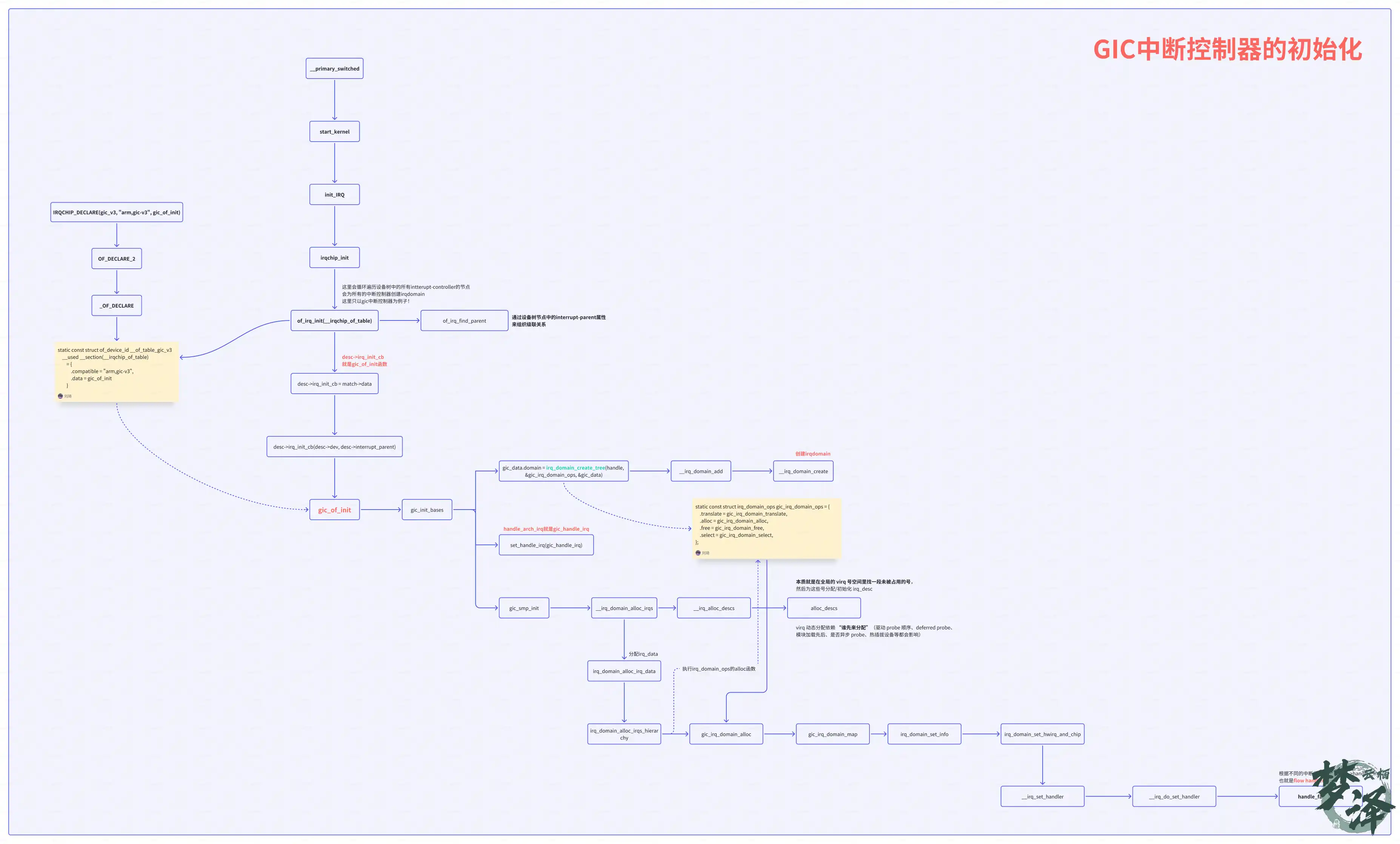
具体的流程就是这样,大家自己看把,有了流程图还是比较清晰的!在本文开头提到的两篇文章中也对其有所赘述。
如果理解有困难,可以通过QEMU以及gdb来设置断点来理清这部分的代码,可以实时查看断点处的变量以及堆栈
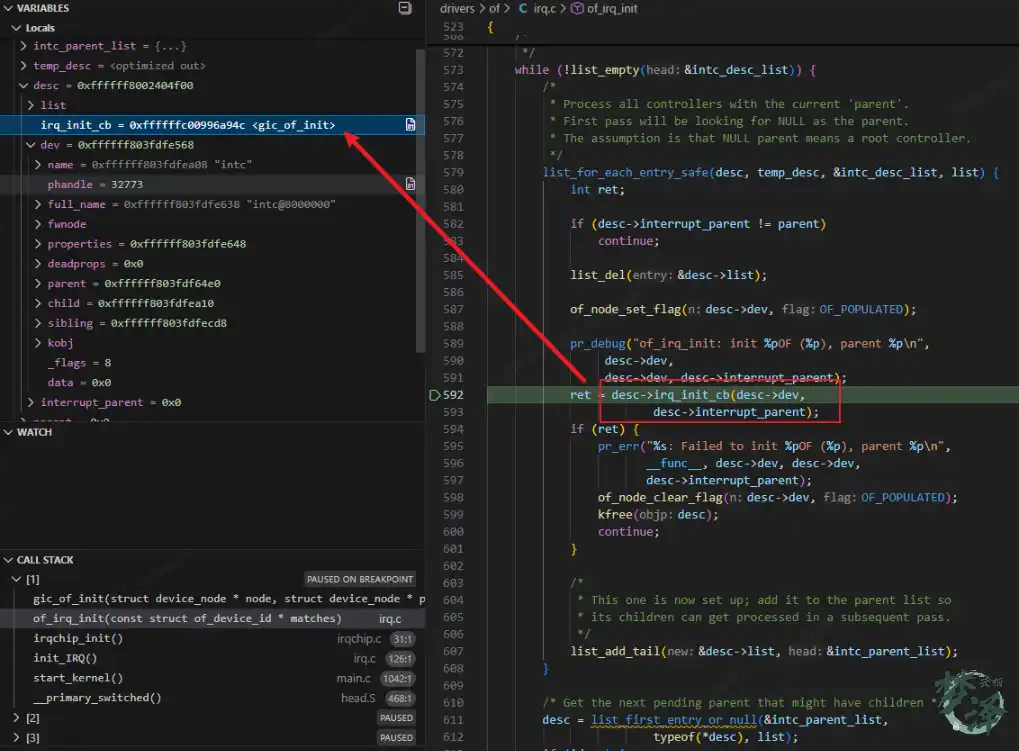
下面以问答的形式回答一下关键的问题点
中断描述符是何时被创建的?
一个设备驱动“用到的那条 IRQ”的 irq_desc 一般不是在 request_irq() 时才创建,而是更早一步:当这条中断第一次被“分配出一个 virq 并建立映射”时就创建了。
比如你在 probe 里调用:
platform_get_irq(pdev, 0)
或of_irq_get(np, 0)/irq_of_parse_and_map(np, 0)
如果这条 DT 中断(对应某个 GIC INTID/hwirq)还没有映射到 Linux virq,内核会:
分配一个新的 virq(全局号)
创建这个 virq 对应的
irq_desc建立 hwirq ↔ virq 映射(revmap)
然后把这个 virq 返回给驱动。
所以很多驱动里会看到:先 platform_get_irq(),再 devm_request_irq() —— irq_desc 往往在前一步就已经有了。
platform_get_irq()
→ of_irq_get() / irq_of_parse_and_map()(drivers/of/irq.c)
→ irq_create_fwspec_mapping()(kernel/irq/irqdomain.c)
→ irq_domain_alloc_irqs() / irq_domain_alloc_irqs_hierarchy()
→ __irq_alloc_descs()(kernel/irq/irqdesc.c)
→ alloc_descs() 创建并初始化 irq_desc
→ domain->ops->alloc() 完成 chip/handler/hwirq 绑定、建立 revmap
这里需要注意的就是:共享中断,如果设备 IRQ 是 共享线(IRQF_SHARED) 或者该 INTID 已经被别人先映射过:
这条 virq 对应的
irq_desc早已存在request_irq()只是在desc->action链表上再挂一个irqaction
中断hwirq和virq的映射
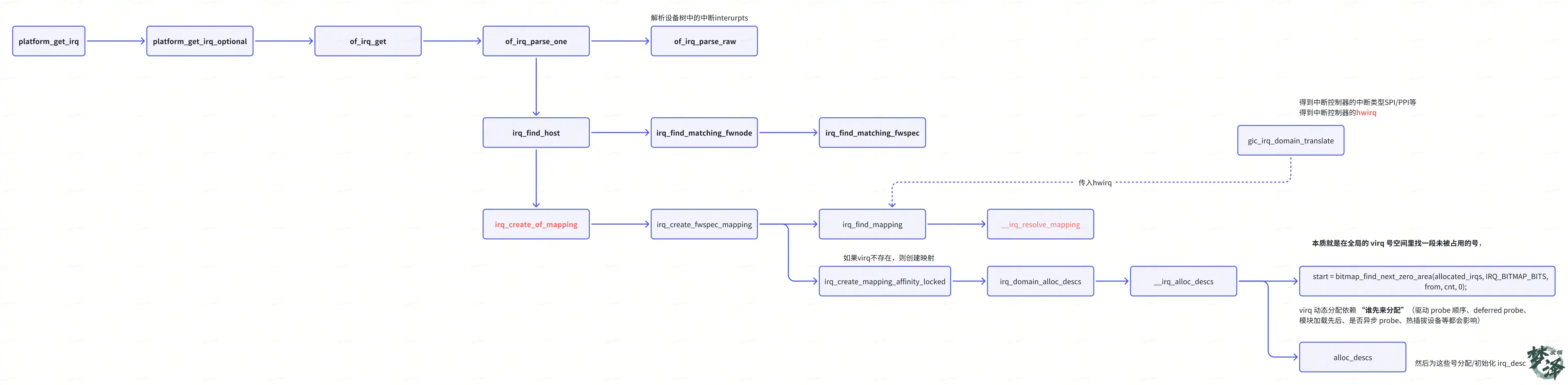
关于hwirq在第一节中我们就提到分为GIC中断控制器和级联的中断控制器
关键函数:
unsigned int irq_create_fwspec_mapping(struct irq_fwspec *fwspec)
{
	struct irq_domain *domain;
	struct irq_data *irq_data;
	irq_hw_number_t hwirq;
	unsigned int type = IRQ_TYPE_NONE;
	int virq;

    // 目的找到fwspec对应的irq_domain
	if (fwspec->fwnode) {
		domain = irq_find_matching_fwspec(fwspec, DOMAIN_BUS_WIRED);
		if (!domain)
			domain = irq_find_matching_fwspec(fwspec, DOMAIN_BUS_ANY);
	} else {
		domain = irq_default_domain;
	}

	if (!domain) {
		pr_warn("no irq domain found for %s !\n",
			of_node_full_name(to_of_node(fwspec->fwnode)));
		return 0;
	}
    // 调用irq_domain_ops中的translate函数翻译,获取hwirq
	if (irq_domain_translate(domain, fwspec, &hwirq, &type))
		return 0;
    // 从相应irq_domain维护的revmap或者revmap_tree中查找hwirq,获取其virq
    virq = irq_find_mapping(domain, hwirq);
    //...
	if (irq_domain_is_hierarchy(domain)) {
		virq = irq_domain_alloc_irqs(domain, 1, NUMA_NO_NODE, fwspec);
		if (virq <= 0)
			return 0;
	} else {
		/* Create mapping */
		virq = irq_create_mapping(domain, hwirq);
		if (!virq)
			return virq;
	}
}通irq_create_mapping创建映射
unsigned int irq_create_mapping_affinity(struct irq_domain *domain,
				       irq_hw_number_t hwirq,
				       const struct irq_affinity_desc *affinity)
{
	struct device_node *of_node;
	int virq;

	pr_debug("irq_create_mapping(0x%p, 0x%lx)\n", domain, hwirq);

	/* Look for default domain if necessary */
	if (domain == NULL)
		domain = irq_default_domain;
	if (domain == NULL) {
		WARN(1, "%s(, %lx) called with NULL domain\n", __func__, hwirq);
		return 0;
	}
	pr_debug("-> using domain @%p\n", domain);

	of_node = irq_domain_get_of_node(domain);

	/* Check if mapping already exists */
	virq = irq_find_mapping(domain, hwirq);
	if (virq) {
		pr_debug("-> existing mapping on virq %d\n", virq);
		return virq;
	}

	/* Allocate a virtual interrupt number */
	virq = irq_domain_alloc_descs(-1, 1, hwirq, of_node_to_nid(of_node),
				      affinity);
	if (virq <= 0) {
		pr_debug("-> virq allocation failed\n");
		return 0;
	}

	if (irq_domain_associate(domain, virq, hwirq)) {
		irq_free_desc(virq);
		return 0;
	}

	pr_debug("irq %lu on domain %s mapped to virtual irq %u\n",
		hwirq, of_node_full_name(of_node), virq);

	return virq;
}通irq_domain_alloc_descs 分配
	start = bitmap_find_next_zero_area(allocated_irqs, IRQ_BITMAP_BITS,
					   from, cnt, 0);
找一个没有使用过的virq返回
irq_data的分配
GIC中断控制器的irq_data分配
当设备是位于GIC中断控制器时,分配函数走的是gic_irq_domain_ops的alloc函数,也就gic_irq_domain_alloc

(1) 填 irq_data 的桥接信息
把 virq/hwirq/domain 串起来。
(2) 绑定 irqchip + flow handler(决定 desc->handle_irq)
通常通过 irq_domain_set_info() 或 irq_set_chip_and_handler*() 之类完成:
绑定
irq_chip(GIC 的 chip)设置 flow handler(很多 SPI/PPI 常见是
handle_fasteoi_irq)
(3) 最关键:写入 revmap(hwirq → irq_data)
最终必须把这条映射放进 domain 的反向映射表,否则你中断路径 __irq_resolve_mapping() 查不到。
级联中断控制器上的irq_data分配
子控制器内部的 N 个中断源:走子控制器自己的 irq_domain 映射
子控制器通常会自己创建一个 irq_domain(例如 gpio-domain),把“GPIO pin号/子中断号”当作 hwirq:
设备 A 使用 GPIO#17 做中断:它的
interrupt-parent = <&gpio>; interrupts = <17 ...>;当设备 A probe 时
platform_get_irq()解析到 gpio_domain,然后会触发:gpio_domain->ops->alloc()(或旧的.map())分配一个新的 virq/desc,并把
hwirq=17 → virq写进 gpio_domain 的 revmap
❌ 这一步 不走 gic_irq_domain_alloc(),因为它根本不是 GIC domain 的中断。
案例:高通平台tlmm中断控制器
这里可以找一个案例:高通平台的tlmm中断控制器,代码位于:drivers/pinctrl/qcom/pinctrl-msm.c
设备树中它是这么显示的:
	tlmm: pinctrl@400000 {
		compatible = "qcom,pitti-pinctrl";                  // 与驱动匹配
		reg = <0x400000 0x1000000>;
		interrupts = <GIC_SPI 227 IRQ_TYPE_LEVEL_HIGH>;     // 表示其连接在GIC中断控制器的227号共享类型中断上
		gpio-controller;                                    // 标明是一个gpio控制器
		#gpio-cells = <2>;
		interrupt-controller;                               // 标明是一个中断控制器
		#interrupt-cells = <2>;
		wakeup-parent = <&mpm>;
		qcom,gpios-reserved = <36 37 38 39>;
	};
很明显tlmm是一个中断控制器,同时它也是一个gpio控制器
如我们之前的分析,irq-domain的创建以及virq与hwirq的映射是通过irq_domain_ops.alloc来设置的,但是翻遍整个pinctrl-msm.c都没有发现irq_domain_ops的设置。那是不是意味着我们之前分析的是有问题的???
其实不然,由于tlmm同时也是一个gpio中断控制器,tlmm的驱动将irq_domain_ops的设置放在了gpiolib里。
static const struct irq_chip msm_gpio_irq_chip = {
	.name			= "msmgpio",
	.irq_enable		= msm_gpio_irq_enable,
	.irq_disable		= msm_gpio_irq_disable,
	.irq_mask		= msm_gpio_irq_mask,
	.irq_unmask		= msm_gpio_irq_unmask,
	.irq_ack		= msm_gpio_irq_ack,
	.irq_eoi		= msm_gpio_irq_eoi,
	.irq_set_type		= msm_gpio_irq_set_type,
	.irq_set_wake		= msm_gpio_irq_set_wake,
	.irq_request_resources	= msm_gpio_irq_reqres,
	.irq_release_resources	= msm_gpio_irq_relres,
	.irq_set_affinity	= msm_gpio_irq_set_affinity,
	.irq_set_irqchip_state = msm_gpio_irq_set_irqchip_state,
	.irq_get_irqchip_state = msm_gpio_irq_get_irqchip_state,
	.irq_set_vcpu_affinity	= msm_gpio_irq_set_vcpu_affinity,
	.flags			= (IRQCHIP_MASK_ON_SUSPEND |
				   IRQCHIP_SET_TYPE_MASKED |
				   IRQCHIP_ENABLE_WAKEUP_ON_SUSPEND |
				   IRQCHIP_IMMUTABLE),
};

static int msm_gpio_init(struct msm_pinctrl *pctrl)
{
	struct gpio_chip *chip;
	struct gpio_irq_chip *girq;
//...
	chip = &pctrl->chip;      //msm_pinctrl的chip成员
	chip->base = -1;
	chip->ngpio = ngpio;
	chip->label = dev_name(pctrl->dev);
	chip->parent = pctrl->dev;
	chip->owner = THIS_MODULE;
    //...
	girq = &chip->irq;         // 填充msm_pinctrl的chip结构中的irq成员
	gpio_irq_chip_set_chip(girq, &msm_gpio_irq_chip);
	girq->parent_handler = msm_gpio_irq_handler;
	girq->fwnode = pctrl->dev->fwnode;
	girq->num_parents = 1;
	girq->parents = devm_kcalloc(pctrl->dev, 1, sizeof(*girq->parents),
				     GFP_KERNEL);
	if (!girq->parents)
		return -ENOMEM;
	girq->default_type = IRQ_TYPE_NONE;
	girq->handler = handle_bad_irq;
	girq->parents[0] = pctrl->irq;

	ret = gpiochip_add_data(&pctrl->chip, pctrl);  //注册irq_domain
    //...
}这个girqstruct gpio_irq_chip
/**
 * struct gpio_irq_chip - GPIO interrupt controller
 */
struct gpio_irq_chip {
	/**
	 * @chip:
	 *
	 * GPIO IRQ chip implementation, provided by GPIO driver.
	 */
	struct irq_chip *chip;

	/**
	 * @domain:
	 *
	 * Interrupt translation domain; responsible for mapping between GPIO
	 * hwirq number and Linux IRQ number.
	 */
	struct irq_domain *domain;

	/**
	 * @domain_ops:
	 *
	 * Table of interrupt domain operations for this IRQ chip.
	 */
	const struct irq_domain_ops *domain_ops;

#ifdef CONFIG_IRQ_DOMAIN_HIERARCHY
	/**
	 * @fwnode:
	 *
	 * Firmware node corresponding to this gpiochip/irqchip, necessary
	 * for hierarchical irqdomain support.
	 */
	struct fwnode_handle *fwnode;

	/**
	 * @parent_domain:
	 *
	 * If non-NULL, will be set as the parent of this GPIO interrupt
	 * controller's IRQ domain to establish a hierarchical interrupt
	 * domain. The presence of this will activate the hierarchical
	 * interrupt support.
	 */
	struct irq_domain *parent_domain;

///......
}
很明显高通针对它这套pinctrl系统,把相关的结构体都封装在了一起,这个girq里记录的就是这个中断控制器tlmm的irq_chip。高通代码有一个很好的点,就是针对这些复杂的结构都会有一个静态的static变量来保存这个,所以我们可以很方便的借助trace32/crash来分析其内部结构。比如该驱动中的
struct msm_pinctrl {
	struct device *dev;
	struct pinctrl_dev *pctrl;
	struct gpio_chip chip;
	struct pinctrl_desc desc;
	struct notifier_block restart_nb;

	int irq;
	int n_dir_conns;

	bool intr_target_use_scm;

	raw_spinlock_t lock;

	DECLARE_BITMAP(dual_edge_irqs, MAX_NR_GPIO);
	DECLARE_BITMAP(enabled_irqs, MAX_NR_GPIO);
	DECLARE_BITMAP(skip_wake_irqs, MAX_NR_GPIO);
	DECLARE_BITMAP(disabled_for_mux, MAX_NR_GPIO);
	DECLARE_BITMAP(ever_gpio, MAX_NR_GPIO);

	const struct msm_pinctrl_soc_data *soc;
	void __iomem *regs[MAX_NR_TILES];
	u32 phys_base[MAX_NR_TILES];

	struct msm_gpio_regs *gpio_regs;
	struct msm_tile *msm_tile_regs;
	bool hibernation;
};

static struct msm_pinctrl *msm_pinctrl_data;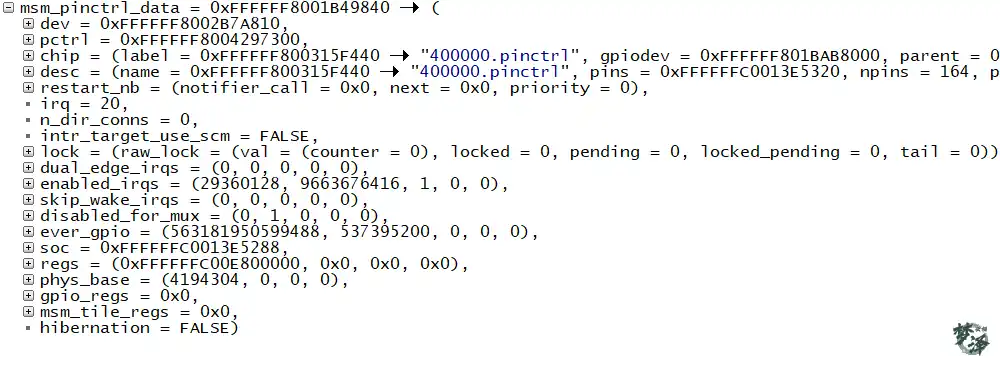
查gpiochip_add_data函数
#define gpiochip_add_data(gc, data) ({		\
		static struct lock_class_key lock_key;	\
		static struct lock_class_key request_key;	  \
		gpiochip_add_data_with_key(gc, data, &lock_key, \
					   &request_key);	  \
	})
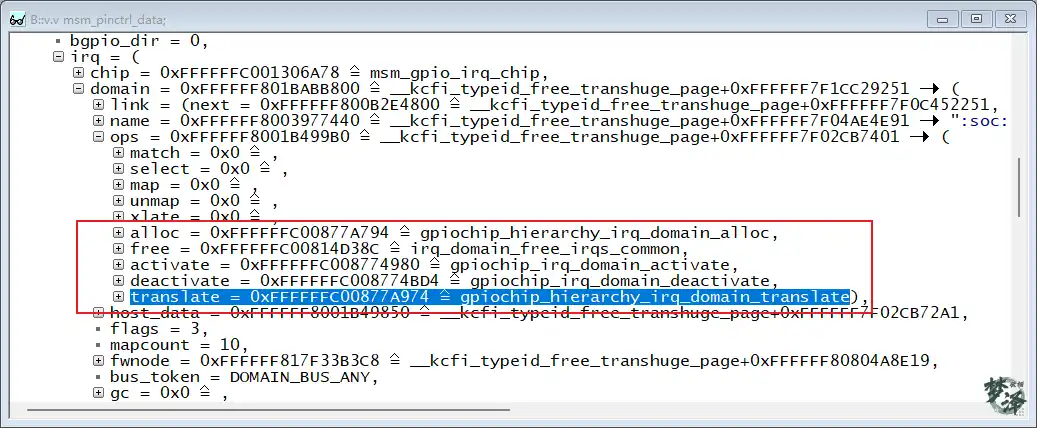
朝后我就不追了,大家自行追一下代码,追到最后可以到这个函数
static void gpiochip_hierarchy_setup_domain_ops(struct irq_domain_ops *ops)
{
	ops->activate = gpiochip_irq_domain_activate;
	ops->deactivate = gpiochip_irq_domain_deactivate;
	ops->alloc = gpiochip_hierarchy_irq_domain_alloc;

	/*
	 * We only allow overriding the translate() and free() functions for
	 * hierarchical chips, and this should only be done if the user
	 * really need something other than 1:1 translation for translate()
	 * callback and free if user wants to free up any resources which
	 * were allocated during callbacks, for example populate_parent_alloc_arg.
	 */
	if (!ops->translate)
		ops->translate = gpiochip_hierarchy_irq_domain_translate;
	if (!ops->free)
		ops->free = irq_domain_free_irqs_common;
}
static int gpiochip_hierarchy_irq_domain_alloc(struct irq_domain *d,
					       unsigned int irq,
					       unsigned int nr_irqs,
					       void *data)
{
	struct gpio_chip *gc = d->host_data;
	irq_hw_number_t hwirq;
	unsigned int type = IRQ_TYPE_NONE;
	struct irq_fwspec *fwspec = data;
	union gpio_irq_fwspec gpio_parent_fwspec = {};
	unsigned int parent_hwirq;
	unsigned int parent_type;
	struct gpio_irq_chip *girq = &gc->irq;
	int ret;

	/*
	 * The nr_irqs parameter is always one except for PCI multi-MSI
	 * so this should not happen.
	 */
	WARN_ON(nr_irqs != 1);

	ret = gc->irq.child_irq_domain_ops.translate(d, fwspec, &hwirq, &type);   //从trace32可以直接得到为gpiochip_hierarchy_irq_domain_translate函数
	if (ret)
		return ret;

	chip_dbg(gc, "allocate IRQ %d, hwirq %lu\n", irq,  hwirq);

	ret = girq->child_to_parent_hwirq(gc, hwirq, type,
					  &parent_hwirq, &parent_type);
	if (ret) {
		chip_err(gc, "can't look up hwirq %lu\n", hwirq);
		return ret;
	}
	chip_dbg(gc, "found parent hwirq %u\n", parent_hwirq);

	/*
	 * We set handle_bad_irq because the .set_type() should
	 * always be invoked and set the right type of handler.
	 */
	irq_domain_set_info(d,
			    irq,
			    hwirq,
			    gc->irq.chip,
			    gc,
			    girq->handler,
			    NULL, NULL);
	irq_set_probe(irq);

	/* This parent only handles asserted level IRQs */
	ret = girq->populate_parent_alloc_arg(gc, &gpio_parent_fwspec,
					      parent_hwirq, parent_type);
	if (ret)
		return ret;

	chip_dbg(gc, "alloc_irqs_parent for %d parent hwirq %d\n",
		  irq, parent_hwirq);
	irq_set_lockdep_class(irq, gc->irq.lock_key, gc->irq.request_key);
	ret = irq_domain_alloc_irqs_parent(d, irq, 1, &gpio_parent_fwspec);
	/*
	 * If the parent irqdomain is msi, the interrupts have already
	 * been allocated, so the EEXIST is good.
	 */
	if (irq_domain_is_msi(d->parent) && (ret == -EEXIST))
		ret = 0;
	if (ret)
		chip_err(gc,
			 "failed to allocate parent hwirq %d for hwirq %lu\n",
			 parent_hwirq, hwirq);

	return ret;
}
这个就是gpiolib(GPIO 子系统)给“GPIO 作为层级 irq_domain”用的 .alloc 回调
谁调用了gpiolib的alloc回调
当某个外设在 DT 里写了:
interrupt-parent = <&tlmm>;interrupts = <gpio_num flags>;(TLMM 常见#interrupt-cells = <2>)
驱动 probe 调 platform_get_irq()/of_irq_get() 时,会走到 irq_create_fwspec_mapping(),最终对 TLMM 的 GPIO irq_domain 触发一次 irq_domain_alloc_irqs_hierarchy(),然后调用到:
d->ops->alloc == gpiochip_hierarchy_irq_domain_alloc解析fwspec
ret = gc->irq.child_irq_domain_ops.translate(d, fwspec, &hwirq, &type); //从trace32可以直接得到为gpiochip_hierarchy_irq_domain_translate函数
fwspec就是 DT 解析出来的参数(对 TLMM 通常就是<gpio_num flags>)translate()输出:hwirq:子域硬件号,对 TLMM 就是 GPIO 编号type:触发类型(edge/level 等)
子 hwirq 怎么映射到父域的 hwirq/type
ret = girq->child_to_parent_hwirq(gc, hwirq, type,
                                 &parent_hwirq, &parent_type);
这一步非常关键:只有在“层级(hierarchy)模型”下才需要。
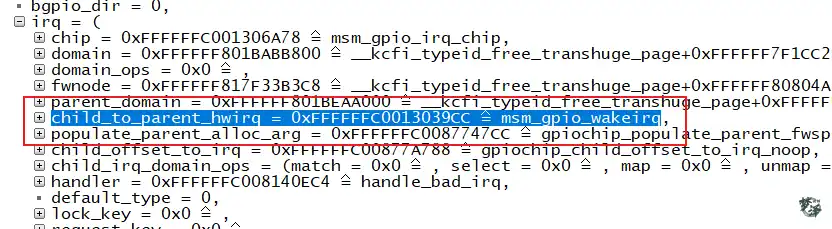
对 TLMM 这种“正常工作靠 summary IRQ(一个父 IRQ)+ 扫描 TLMM pending 寄存器”的模式,严格来说“每个 GPIO 并没有一个独立的 GIC parent_hwirq”。
但高通平台经常还有 wakeup-parent / MPM 之类的上层唤醒域:某些 GPIO 在低功耗唤醒路径下,确实要映射到“唤醒控制器/MPM”的某个 parent_hwirq。
在
pinctrl-msm.c里看到的:chip->irq.parent_domain = irq_find_matching_host(np, DOMAIN_BUS_WAKEUP);chip->irq.child_to_parent_hwirq = msm_gpio_wakeirq;
就是把这一步的函数指针设成 “GPIO → wakeirq(MPM线)” 的映射。
所以这段代码本质是:算出这个 GPIO 子中断,在 parent 域里对应哪个硬件号(以及触发类型)
填充子域
irq_domain_set_info(d, irq, hwirq,
                    gc->irq.chip, gc,
                    girq->handler,
                    NULL, NULL);
irq_set_probe(irq);
irq_data->hwirq = hwirq✅(子域 hwirq:GPIO 编号)irq_data->chip = gc->irq.chip✅(TLMM 的 irq_chip)irq_data->chip_data = gc✅irq_desc(virq)->handle_irq = girq->handler✅(flow handler,先设成handle_bad_irq,后面.set_type()会改成正确的)
中断注册流程
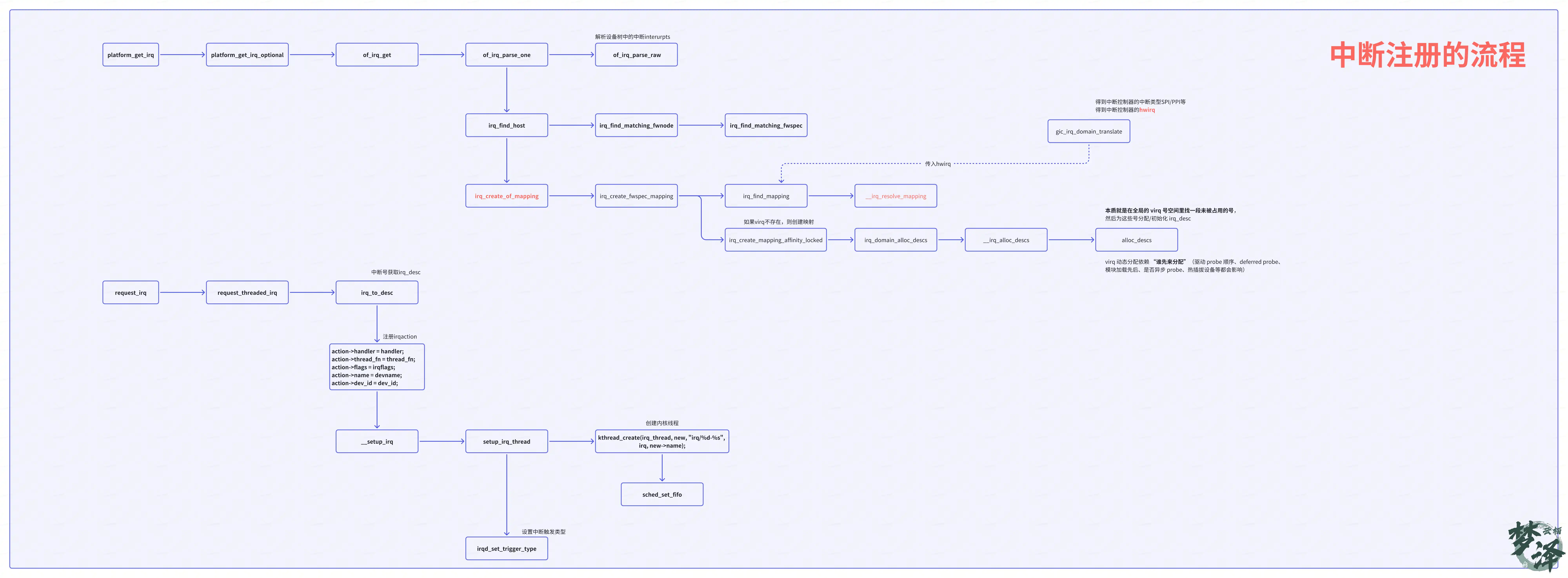
int request_threaded_irq(unsigned int irq, irq_handler_t handler,
			 irq_handler_t thread_fn, unsigned long irqflags,
			 const char *devname, void *dev_id)
{
	struct irqaction *action;
	struct irq_desc *desc;
	int retval;

	if (irq == IRQ_NOTCONNECTED)
		return -ENOTCONN;

	/*
	 * Sanity-check: shared interrupts must pass in a real dev-ID,
	 * otherwise we'll have trouble later trying to figure out
	 * which interrupt is which (messes up the interrupt freeing
	 * logic etc).
	 *
	 * Also shared interrupts do not go well with disabling auto enable.
	 * The sharing interrupt might request it while it's still disabled
	 * and then wait for interrupts forever.
	 *
	 * Also IRQF_COND_SUSPEND only makes sense for shared interrupts and
	 * it cannot be set along with IRQF_NO_SUSPEND.
	 */
	if (((irqflags & IRQF_SHARED) && !dev_id) ||			//如果设置了共享中断,dev_id不能为空
	    ((irqflags & IRQF_SHARED) && (irqflags & IRQF_NO_AUTOEN)) ||
	    (!(irqflags & IRQF_SHARED) && (irqflags & IRQF_COND_SUSPEND)) ||
	    ((irqflags & IRQF_NO_SUSPEND) && (irqflags & IRQF_COND_SUSPEND)))
		return -EINVAL;

	desc = irq_to_desc(irq);	//从中断号获取中断描述符
	if (!desc)
		return -EINVAL;

	if (!irq_settings_can_request(desc) ||	//判断中断描述符是否可以被请求
	    WARN_ON(irq_settings_is_per_cpu_devid(desc)))
		return -EINVAL;

	if (!handler) {	//判断中断处理函数是否为空
		if (!thread_fn)	//如果中断处理函数为空,判断中断线程化处理函数是否为空
			return -EINVAL;
		//如果中断线程化,且中断处理函数为空,走默认的中断处理函数
		handler = irq_default_primary_handler;
	}

	// 分配一个struct irqaction空间
	action = kzalloc(sizeof(struct irqaction), GFP_KERNEL);
	if (!action)
		return -ENOMEM;

	action->handler = handler;
	action->thread_fn = thread_fn;
	action->flags = irqflags;
	action->name = devname;
	action->dev_id = dev_id;

	retval = irq_chip_pm_get(&desc->irq_data);
	if (retval < 0) {
		kfree(action);
		return retval;
	}

	// 设置中断的函数
	retval = __setup_irq(irq, desc, action);

	if (retval) {
		irq_chip_pm_put(&desc->irq_data);
		kfree(action->secondary);
		kfree(action);
	}

#ifdef CONFIG_DEBUG_SHIRQ_FIXME
	if (!retval && (irqflags & IRQF_SHARED)) {
		/*
		 * It's a shared IRQ -- the driver ought to be prepared for it
		 * to happen immediately, so let's make sure....
		 * We disable the irq to make sure that a 'real' IRQ doesn't
		 * run in parallel with our fake.
		 */
		unsigned long flags;

		disable_irq(irq);
		local_irq_save(flags);

		handler(irq, dev_id);

		local_irq_restore(flags);
		enable_irq(irq);
	}
#endif
	return retval;
}
参数
irq:中断号,指定请求哪个中断。handler:主中断处理函数,通常在硬中断上下文中执行。thread_fn:线程化中断处理函数,通常在软中断上下文中执行(如果没有handler,会使用这个)。irqflags:设置中断的标志(例如是否共享中断、是否启用线程化等)。devname:设备名称(中断的名称,通常显示在/proc/interrupts)。dev_id:设备 ID,用于区分共享中断的不同设备。
验证输入参数的有效性
if (((irqflags & IRQF_SHARED) && !dev_id) ||			// 如果设置了共享中断,dev_id不能为空
    ((irqflags & IRQF_SHARED) && (irqflags & IRQF_NO_AUTOEN)) ||
    (!(irqflags & IRQF_SHARED) && (irqflags & IRQF_COND_SUSPEND)) ||
    ((irqflags & IRQF_NO_SUSPEND) && (irqflags & IRQF_COND_SUSPEND)))
    return -EINVAL;
这里对 irqflags 参数进行了一些基本验证:
如果设置了
IRQF_SHARED(共享中断),必须传递dev_id,否则会返回-EINVAL。禁用了自动使能的共享中断(
IRQF_NO_AUTOEN)是不合法的。IRQF_COND_SUSPEND和IRQF_NO_SUSPEND是互斥的,这两者不能同时设置。
处理函数检查
if (!handler) { // 判断中断处理函数是否为空
    if (!thread_fn) // 如果中断处理函数为空,判断中断线程化处理函数是否为空
        return -EINVAL;
    handler = irq_default_primary_handler; // 如果线程化,且中断处理函数为空,走默认的处理函数
}
如果 handler 为空,则必须提供一个 thread_fn 作为线程化的中断处理函数;如果两者都为空,返回 -EINVAL 错误。如果只提供了 thread_fn,则将 handler 设置为默认的主中断处理函数 irq_default_primary_handler。
irqaction初始化
action->handler = handler;
action->thread_fn = thread_fn;
action->flags = irqflags;
action->name = devname;
action->dev_id = dev_id;
填充 irqaction 结构体,将中断处理函数、线程化处理函数、标志、设备信息等写入。
获取 irq_desc 的电源管理状态
retval = irq_chip_pm_get(&desc->irq_data);
if (retval < 0) {
    kfree(action);
    return retval;
}
调用 irq_chip_pm_get() 获取与 irq_desc 相关的电源管理状态。如果失败,释放分配的内存并返回错误。
设置中断处理函数
retval = __setup_irq(irq, desc, action);调用 __setup_irq() 来设置 irq_desc,这将把中断的 handler(主处理函数)和 thread_fn(线程化处理函数)与中断号 irq 绑定起来。
__setup_irq() 函数是 Linux 内核中用于 设置中断请求 的核心函数之一,它负责初始化中断处理程序、线程化处理以及对共享和线程化中断的管理。下面我将详细分析函数的每一部分。
static int
__setup_irq(unsigned int irq, struct irq_desc *desc, struct irqaction *new)
{
	struct irqaction *old, **old_ptr;
	unsigned long flags, thread_mask = 0;
	int ret, nested, shared = 0;

	if (!desc)
		return -EINVAL;

	if (desc->irq_data.chip == &no_irq_chip)
		return -ENOSYS;
	if (!try_module_get(desc->owner))
		return -ENODEV;

	new->irq = irq;

	/*
	 * If the trigger type is not specified by the caller,
	 * then use the default for this interrupt.
	 */
	if (!(new->flags & IRQF_TRIGGER_MASK))
		new->flags |= irqd_get_trigger_type(&desc->irq_data);

	/*
	 * Check whether the interrupt nests into another interrupt
	 * thread.
	 */
	//判断是否是嵌套线程
	nested = irq_settings_is_nested_thread(desc);
	if (nested) {
		if (!new->thread_fn) {
			ret = -EINVAL;
			goto out_mput;
		}
		/*
		 * Replace the primary handler which was provided from
		 * the driver for non nested interrupt handling by the
		 * dummy function which warns when called.
		 */
		new->handler = irq_nested_primary_handler;
	} else {
		// 判断中断设置是否线程化
		if (irq_settings_can_thread(desc)) {
			ret = irq_setup_forced_threading(new);
			if (ret)
				goto out_mput;
		}
	}

	/*
	 * Create a handler thread when a thread function is supplied
	 * and the interrupt does not nest into another interrupt
	 * thread.
	 */
	//如果线程化没有嵌套,则走这里
	if (new->thread_fn && !nested) {
		// 设置中断线程
		ret = setup_irq_thread(new, irq, false);
		if (ret)
			goto out_mput;
		if (new->secondary) {
			ret = setup_irq_thread(new->secondary, irq, true);
			if (ret)
				goto out_thread;
		}
	}

	/*
	 * Drivers are often written to work w/o knowledge about the
	 * underlying irq chip implementation, so a request for a
	 * threaded irq without a primary hard irq context handler
	 * requires the ONESHOT flag to be set. Some irq chips like
	 * MSI based interrupts are per se one shot safe. Check the
	 * chip flags, so we can avoid the unmask dance at the end of
	 * the threaded handler for those.
	 */
	//中断描述符如果支持IRQCHIP_ONESHOT_SAFE,则需要清楚IRQF_ONESHOT,
	// IRQCHIP_ONESHOT_SAFE是一个中断控制器的特定标志,用于指定该控制器
	// 是否支持硬件级别的oneshot中断
	if (desc->irq_data.chip->flags & IRQCHIP_ONESHOT_SAFE)
		new->flags &= ~IRQF_ONESHOT;

	/*
	 * Protects against a concurrent __free_irq() call which might wait
	 * for synchronize_hardirq() to complete without holding the optional
	 * chip bus lock and desc->lock. Also protects against handing out
	 * a recycled oneshot thread_mask bit while it's still in use by
	 * its previous owner.
	 */
	mutex_lock(&desc->request_mutex);

	/*
	 * Acquire bus lock as the irq_request_resources() callback below
	 * might rely on the serialization or the magic power management
	 * functions which are abusing the irq_bus_lock() callback,
	 */
	chip_bus_lock(desc);

	/* First installed action requests resources. */
	// 判断中断描述符的struct irqaction成员是否为空
	if (!desc->action) {
		ret = irq_request_resources(desc); // 用于分配和配置中断相关的资源
		if (ret) {
			pr_err("Failed to request resources for %s (irq %d) on irqchip %s\n",
			       new->name, irq, desc->irq_data.chip->name);
			goto out_bus_unlock;
		}
	}

	/*
	 * The following block of code has to be executed atomically
	 * protected against a concurrent interrupt and any of the other
	 * management calls which are not serialized via
	 * desc->request_mutex or the optional bus lock.
	 */
	raw_spin_lock_irqsave(&desc->lock, flags);
	old_ptr = &desc->action;
	old = *old_ptr;
	if (old) {
		/*
		 * Can't share interrupts unless both agree to and are
		 * the same type (level, edge, polarity). So both flag
		 * fields must have IRQF_SHARED set and the bits which
		 * set the trigger type must match. Also all must
		 * agree on ONESHOT.
		 * Interrupt lines used for NMIs cannot be shared.
		 */
		unsigned int oldtype;

		if (desc->istate & IRQS_NMI) {
			pr_err("Invalid attempt to share NMI for %s (irq %d) on irqchip %s.\n",
				new->name, irq, desc->irq_data.chip->name);
			ret = -EINVAL;
			goto out_unlock;
		}

		/*
		 * If nobody did set the configuration before, inherit
		 * the one provided by the requester.
		 */
		// 中断触发类型如果被设置了
		if (irqd_trigger_type_was_set(&desc->irq_data)) {
			oldtype = irqd_get_trigger_type(&desc->irq_data);
		} else {
			// 中断触发类型如果没有被设置
			oldtype = new->flags & IRQF_TRIGGER_MASK;
			irqd_set_trigger_type(&desc->irq_data, oldtype); //设置中断触发类型
		}

		if (!((old->flags & new->flags) & IRQF_SHARED) ||
		    (oldtype != (new->flags & IRQF_TRIGGER_MASK)) ||
		    ((old->flags ^ new->flags) & IRQF_ONESHOT))
			goto mismatch;

		/* All handlers must agree on per-cpuness */
		if ((old->flags & IRQF_PERCPU) !=
		    (new->flags & IRQF_PERCPU))	//IRQF_PERCPU用于指定中断是否与每个CPU关联
			goto mismatch;

		/* add new interrupt at end of irq queue */
		do {
			/*
			 * Or all existing action->thread_mask bits,
			 * so we can find the next zero bit for this
			 * new action.
			 */
			thread_mask |= old->thread_mask;
			old_ptr = &old->next;
			old = *old_ptr;
		} while (old);
		shared = 1;
	}

	/*
	 * Setup the thread mask for this irqaction for ONESHOT. For
	 * !ONESHOT irqs the thread mask is 0 so we can avoid a
	 * conditional in irq_wake_thread().
	 */
	// 是否设置了中断处理程序只被触发一次后立即禁用
	if (new->flags & IRQF_ONESHOT) {
		/*
		 * Unlikely to have 32 resp 64 irqs sharing one line,
		 * but who knows.
		 */
		if (thread_mask == ~0UL) {
			ret = -EBUSY;
			goto out_unlock;
		}
		/*
		 * The thread_mask for the action is or'ed to
		 * desc->thread_active to indicate that the
		 * IRQF_ONESHOT thread handler has been woken, but not
		 * yet finished. The bit is cleared when a thread
		 * completes. When all threads of a shared interrupt
		 * line have completed desc->threads_active becomes
		 * zero and the interrupt line is unmasked. See
		 * handle.c:irq_wake_thread() for further information.
		 *
		 * If no thread is woken by primary (hard irq context)
		 * interrupt handlers, then desc->threads_active is
		 * also checked for zero to unmask the irq line in the
		 * affected hard irq flow handlers
		 * (handle_[fasteoi|level]_irq).
		 *
		 * The new action gets the first zero bit of
		 * thread_mask assigned. See the loop above which or's
		 * all existing action->thread_mask bits.
		 */
		new->thread_mask = 1UL << ffz(thread_mask);

	} else if (new->handler == irq_default_primary_handler &&
		   !(desc->irq_data.chip->flags & IRQCHIP_ONESHOT_SAFE)) {
		/*
		 * The interrupt was requested with handler = NULL, so
		 * we use the default primary handler for it. But it
		 * does not have the oneshot flag set. In combination
		 * with level interrupts this is deadly, because the
		 * default primary handler just wakes the thread, then
		 * the irq lines is reenabled, but the device still
		 * has the level irq asserted. Rinse and repeat....
		 *
		 * While this works for edge type interrupts, we play
		 * it safe and reject unconditionally because we can't
		 * say for sure which type this interrupt really
		 * has. The type flags are unreliable as the
		 * underlying chip implementation can override them.
		 */
		pr_err("Threaded irq requested with handler=NULL and !ONESHOT for %s (irq %d)\n",
		       new->name, irq);
		ret = -EINVAL;
		goto out_unlock;
	}

	if (!shared) { // 如果没有设置共享中断
		init_waitqueue_head(&desc->wait_for_threads); // 初始化等待队列

		/* Setup the type (level, edge polarity) if configured: */
		if (new->flags & IRQF_TRIGGER_MASK) {
			ret = __irq_set_trigger(desc,
						new->flags & IRQF_TRIGGER_MASK);	// 设置中断触发类型

			if (ret)
				goto out_unlock;
		}

		/*
		 * Activate the interrupt. That activation must happen
		 * independently of IRQ_NOAUTOEN. request_irq() can fail
		 * and the callers are supposed to handle
		 * that. enable_irq() of an interrupt requested with
		 * IRQ_NOAUTOEN is not supposed to fail. The activation
		 * keeps it in shutdown mode, it merily associates
		 * resources if necessary and if that's not possible it
		 * fails. Interrupts which are in managed shutdown mode
		 * will simply ignore that activation request.
		 */
		ret = irq_activate(desc);
		if (ret)
			goto out_unlock;

		desc->istate &= ~(IRQS_AUTODETECT | IRQS_SPURIOUS_DISABLED | \
				  IRQS_ONESHOT | IRQS_WAITING);
		irqd_clear(&desc->irq_data, IRQD_IRQ_INPROGRESS);

		if (new->flags & IRQF_PERCPU) {
			irqd_set(&desc->irq_data, IRQD_PER_CPU);
			irq_settings_set_per_cpu(desc);
			if (new->flags & IRQF_NO_DEBUG)
				irq_settings_set_no_debug(desc);
		}

		if (noirqdebug)
			irq_settings_set_no_debug(desc);

		if (new->flags & IRQF_ONESHOT)
			desc->istate |= IRQS_ONESHOT;

		/* Exclude IRQ from balancing if requested */
		if (new->flags & IRQF_NOBALANCING) {
			irq_settings_set_no_balancing(desc);
			irqd_set(&desc->irq_data, IRQD_NO_BALANCING);
		}

		if (!(new->flags & IRQF_NO_AUTOEN) &&
		    irq_settings_can_autoenable(desc)) {
			irq_startup(desc, IRQ_RESEND, IRQ_START_COND);
		} else {
			/*
			 * Shared interrupts do not go well with disabling
			 * auto enable. The sharing interrupt might request
			 * it while it's still disabled and then wait for
			 * interrupts forever.
			 */
			WARN_ON_ONCE(new->flags & IRQF_SHARED);
			/* Undo nested disables: */
			desc->depth = 1;
		}

	} else if (new->flags & IRQF_TRIGGER_MASK) {
		unsigned int nmsk = new->flags & IRQF_TRIGGER_MASK;
		unsigned int omsk = irqd_get_trigger_type(&desc->irq_data);

		if (nmsk != omsk)
			/* hope the handler works with current  trigger mode */
			pr_warn("irq %d uses trigger mode %u; requested %u\n",
				irq, omsk, nmsk);
	}

	*old_ptr = new;	// 将新的action给中断描述符

	irq_pm_install_action(desc, new);

	/* Reset broken irq detection when installing new handler */
	desc->irq_count = 0;
	desc->irqs_unhandled = 0;

	/*
	 * Check whether we disabled the irq via the spurious handler
	 * before. Reenable it and give it another chance.
	 */
	if (shared && (desc->istate & IRQS_SPURIOUS_DISABLED)) {
		desc->istate &= ~IRQS_SPURIOUS_DISABLED;
		__enable_irq(desc);	//使能中断
	}

	raw_spin_unlock_irqrestore(&desc->lock, flags);
	chip_bus_sync_unlock(desc);
	mutex_unlock(&desc->request_mutex);

	irq_setup_timings(desc, new);	//设置中断控制器的时序参数

	/*
	 * Strictly no need to wake it up, but hung_task complains
	 * when no hard interrupt wakes the thread up.
	 */
	if (new->thread)
		wake_up_process(new->thread);
	if (new->secondary)
		wake_up_process(new->secondary->thread);

	register_irq_proc(irq, desc);	// 注册procfs文件系统
	new->dir = NULL;
	register_handler_proc(irq, new);	// 注册irq文件系统
	return 0;

mismatch:
	if (!(new->flags & IRQF_PROBE_SHARED)) {
		pr_err("Flags mismatch irq %d. %08x (%s) vs. %08x (%s)\n",
		       irq, new->flags, new->name, old->flags, old->name);
#ifdef CONFIG_DEBUG_SHIRQ
		dump_stack();
#endif
	}
	ret = -EBUSY;

out_unlock:
	raw_spin_unlock_irqrestore(&desc->lock, flags);

	if (!desc->action)
		irq_release_resources(desc);
out_bus_unlock:
	chip_bus_sync_unlock(desc);
	mutex_unlock(&desc->request_mutex);

out_thread:
	if (new->thread) {
		struct task_struct *t = new->thread;

		new->thread = NULL;
		kthread_stop(t);
		put_task_struct(t);
	}
	if (new->secondary && new->secondary->thread) {
		struct task_struct *t = new->secondary->thread;

		new->secondary->thread = NULL;
		kthread_stop(t);
		put_task_struct(t);
	}
out_mput:
	module_put(desc->owner);
	return ret;
}
函数总体结构
该函数的工作流程大致分为以下几个部分:
输入参数检查和初始化:验证中断描述符、模块加载等。
中断触发类型的设置:确保中断触发类型已正确设置。
处理中断线程的嵌套问题:判断是否是嵌套线程,如果是,则进行特殊处理。
为中断创建处理线程:设置和创建中断的线程处理程序。
配置中断的资源和状态:为中断分配资源,并进行必要的初始化。
共享中断处理:如果是共享中断,进行进一步的检查和处理。
中断激活和启动:确保中断在适当的时机激活,并设置相应的时序和状态。
设置触发类型
if (!(new->flags & IRQF_TRIGGER_MASK))
    new->flags |= irqd_get_trigger_type(&desc->irq_data);
如果调用者没有明确指定中断触发类型(IRQF_TRIGGER_MASK),则使用 irqd_get_trigger_type() 从 irq_desc 获取默认的触发类型。
判断是否是嵌套线程
nested = irq_settings_is_nested_thread(desc);
if (nested) {
    if (!new->thread_fn) {
        ret = -EINVAL;
        goto out_mput;
    }
    new->handler = irq_nested_primary_handler;
}
嵌套线程:检查当前中断是否是嵌套中断。嵌套中断的处理会使用一个特殊的处理程序 irq_nested_primary_handler,并且要求必须提供一个线程化处理函数 thread_fn。如果没有提供,则返回 -EINVAL。
创建线程化中断处理函数
if (new->thread_fn && !nested) {
    ret = setup_irq_thread(new, irq, false);
    if (ret)
        goto out_mput;
    if (new->secondary) {
        ret = setup_irq_thread(new->secondary, irq, true);
        if (ret)
            goto out_thread;
    }
}
创建中断线程:如果提供了
thread_fn且没有嵌套线程,那么会调用setup_irq_thread()来为该中断创建一个线程。如果有
secondary线程,也会为其创建线程。
检查 ONESHOT 中断
if (desc->irq_data.chip->flags & IRQCHIP_ONESHOT_SAFE)
    new->flags &= ~IRQF_ONESHOT;
ONESHOT 安全:如果中断控制器支持硬件级别的 ONESHOT,则清除 IRQF_ONESHOT 标志,以避免软件层面的 ONESHOT 与硬件冲突。
锁定和请求资源
mutex_lock(&desc->request_mutex);
chip_bus_lock(desc);
if (!desc->action) {
    ret = irq_request_resources(desc);
    if (ret) {
        pr_err("Failed to request resources for %s (irq %d) on irqchip %s\n",
               new->name, irq, desc->irq_data.chip->name);
        goto out_bus_unlock;
    }
}
请求资源:使用 mutex_lock 锁住中断描述符,确保对中断资源的独占访问。然后调用 irq_request_resources() 为该中断分配资源。
检查和处理共享中断
raw_spin_lock_irqsave(&desc->lock, flags);
old_ptr = &desc->action;
old = *old_ptr;
if (old) {
    // 共享中断的处理逻辑
}
共享中断:检查该中断是否已经有处理程序。如果已有处理程序,进行共享中断的配置:
确保触发类型、
IRQF_SHARED标志和IRQF_ONESHOT一致。如果共享中断存在,设置
thread_mask来确保新加入的处理程序能够正确工作。
设置线程掩码
if (new->flags & IRQF_ONESHOT) {
    if (thread_mask == ~0UL) {
        ret = -EBUSY;
        goto out_unlock;
    }
    new->thread_mask = 1UL << ffz(thread_mask);
}
ONESHOT 线程掩码:如果中断设置了 ONESHOT,则为每个 irqaction 分配一个线程掩码,确保该线程只被触发一次。
激活中断并配置触发类型
if (!shared) {
    init_waitqueue_head(&desc->wait_for_threads);
    if (new->flags & IRQF_TRIGGER_MASK) {
        ret = __irq_set_trigger(desc, new->flags & IRQF_TRIGGER_MASK);
        if (ret)
            goto out_unlock;
    }
    ret = irq_activate(desc);
    if (ret)
        goto out_unlock;
}
中断激活:如果中断没有共享,初始化等待队列,并设置中断触发类型(如上升沿、下降沿等)。然后调用 irq_activate() 激活中断。
注册 procfs 文件
register_irq_proc(irq, desc);
register_handler_proc(irq, new);
注册中断到 procfs,方便用户查看和调试。
中断线程的创建
static int
setup_irq_thread(struct irqaction *new, unsigned int irq, bool secondary)
{
	struct task_struct *t;

	if (!secondary) {
		t = kthread_create(irq_thread, new, "irq/%d-%s", irq,
				   new->name);
	} else {
		t = kthread_create(irq_thread, new, "irq/%d-s-%s", irq,
				   new->name);
	}

	if (IS_ERR(t))
		return PTR_ERR(t);

	sched_set_fifo(t);

	/*
	 * We keep the reference to the task struct even if
	 * the thread dies to avoid that the interrupt code
	 * references an already freed task_struct.
	 */
	new->thread = get_task_struct(t);
	/*
	 * Tell the thread to set its affinity. This is
	 * important for shared interrupt handlers as we do
	 * not invoke setup_affinity() for the secondary
	 * handlers as everything is already set up. Even for
	 * interrupts marked with IRQF_NO_BALANCE this is
	 * correct as we want the thread to move to the cpu(s)
	 * on which the requesting code placed the interrupt.
	 */
	set_bit(IRQTF_AFFINITY, &new->thread_flags);
	return 0;
}创建的内核线程函数irq_thread
static int irq_thread(void *data)
{
	struct callback_head on_exit_work;
	struct irqaction *action = data;
	struct irq_desc *desc = irq_to_desc(action->irq);
	irqreturn_t (*handler_fn)(struct irq_desc *desc,
			struct irqaction *action);

	if (force_irqthreads() && test_bit(IRQTF_FORCED_THREAD,
					   &action->thread_flags))
		handler_fn = irq_forced_thread_fn;
	else
		handler_fn = irq_thread_fn;

	init_task_work(&on_exit_work, irq_thread_dtor);
	task_work_add(current, &on_exit_work, TWA_NONE);

	irq_thread_check_affinity(desc, action);

	while (!irq_wait_for_interrupt(action)) {
		irqreturn_t action_ret;

		irq_thread_check_affinity(desc, action);

		action_ret = handler_fn(desc, action);
		if (action_ret == IRQ_WAKE_THREAD)
			irq_wake_secondary(desc, action);

		wake_threads_waitq(desc);
	}

	/*
	 * This is the regular exit path. __free_irq() is stopping the
	 * thread via kthread_stop() after calling
	 * synchronize_hardirq(). So neither IRQTF_RUNTHREAD nor the
	 * oneshot mask bit can be set.
	 */
	task_work_cancel(current, irq_thread_dtor);
	return 0;
}
循环等待中断并处理 中断的下半部处理函数
static int irq_wait_for_interrupt(struct irqaction *action)
{
	for (;;) {
        // 设置线程状态为可中断睡眠:线程可以接收信号和中断唤醒
		set_current_state(TASK_INTERRUPTIBLE);

		if (kthread_should_stop()) {
            // 如果还有中断标志,处理最后一次
			/* may need to run one last time */
			if (test_and_clear_bit(IRQTF_RUNTHREAD,
					       &action->thread_flags)) {
                // 设置线程状态为running,从睡眠状态转为运行状态
				__set_current_state(TASK_RUNNING);
				return 0;
			}
			__set_current_state(TASK_RUNNING);
			return -1;
		}

		if (test_and_clear_bit(IRQTF_RUNTHREAD,
				       &action->thread_flags)) {
			__set_current_state(TASK_RUNNING);
			return 0;
		}
        // 主动让出CPU:进入睡眠状态等待唤醒
		schedule();
	}
}中断下半部的中断线程会主动让出CPU,一直处TASK_INTERRUPTIABLE的睡眠状态,并一直等待硬中断唤醒。
中断触发流程
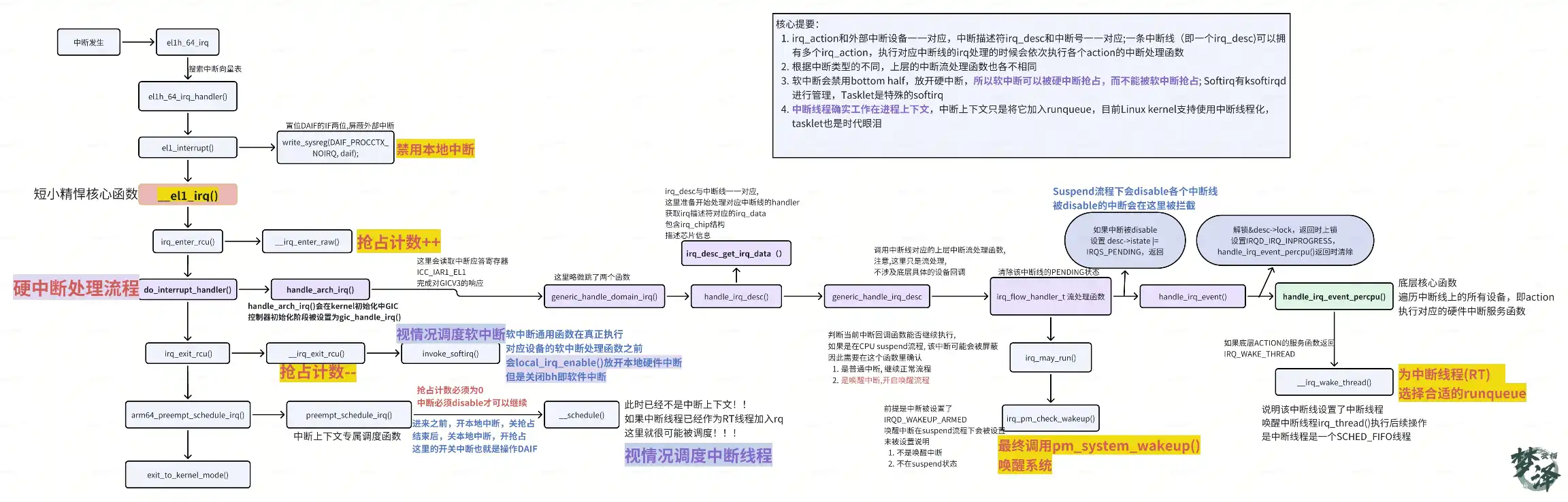
这里贴一下我的同事 @Melokc 绘制的一副中断触发的流程图,其中从gic中断处理到irq_flow_handler处理的流程都详细的标注出了。
PS: 此图的函数基于Linux-6.1的内核,其他内核代码中有部分函数存在差异,但整体的机制是一样的。